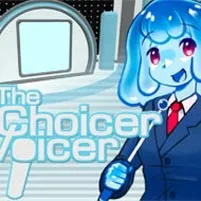
Сhoicer Voicer Review
All trademarks belong to their respective ownersGet More




The Choicer Voicer: The TikTok-Viral Dubbing Game
Somewhere in the last few weeks, clips of people badly, hilariously dubbing their own voices over scenes from shows like Dexter started spreading across TikTok, and the comment sections filled up with a genuinely funny recurring question: is this a real game, or is it just a bit someone made up for the format? It's real. The Choicer Voicer is a small, self-described alpha built by a solo-adjacent developer going by YeahMaybe and sold on itch.io for five dollars, and the gap between how polished it looks in a thirty-second viral clip and what you're actually installing turns out to be the most interesting thing about it. Worth noting upfront too: the game's sudden visibility has already attracted a small swarm of unaffiliated fan sites and lookalike domains promising to let you "play online free," none of which are the actual developer's page — the real thing lives on itch.io, and that distinction matters more than usual for a five-dollar alpha with a known payment page and a known download source.
What You're Actually Buying
Strip away the premise and The Choicer Voicer is a vocal-impression game show simulator: you're handed an audio clip, you try to recreate it with your own voice as closely as you can, and a judge decides how well you pulled it off. That basic loop gets delivered four different ways. In singleplayer, a set of computer-controlled judges score your attempts, which works fine for testing your mic and getting a feel for the format but is clearly not where the game's energy actually lives. Local multiplayer supports up to four people passing a microphone around a room, which is closer to the classic party-game format the developer says the whole thing is modeled after. Streamer mode hands judging duties over to a Twitch chat instead of an AI or a couch full of friends, turning the whole thing into an audience-participation bit for anyone broadcasting. And then there's Dub Mode, the one responsible for essentially all of the TikTok clips currently circulating, where instead of chasing a score you're just recording yourself dubbing dialogue over a favorite scene for its own sake, no judge, no win condition, just the performance itself as the content.
The part that separates The Choicer Voicer from a typical polished party game, and the part that explains why so many viral clips look wildly different from each other, is that the game ships as what the developer bluntly calls a blank canvas. There's no built-in library of licensed movie and TV clips waiting for you on install — the base game gives you the judging system, the show formats, and the recording tools, and then expects players to source their own audio clips, judge characters, studio backdrops, hosts, and menu themes from the community or build their own. That's a genuinely unusual design decision for something this cheap and this early in development: most games try to hide how thin their initial content is behind a wall of built-in assets, while this one is upfront that you're buying a framework, not a finished product, and that the actual fun depends on whichever content packs you go find or make yourself.
At five dollars with a free demo available specifically for testing whether your microphone setup even works with it, the asking price matches that honesty — you're not paying for a curated library, you're paying for the engine underneath one. That framework-first approach also explains why the game runs entirely on folders rather than an in-app store or marketplace — building a custom show means dropping audio clips, judge sprites, and studio backgrounds into the right directories yourself, closer to how someone might mod an old PC game than how most people expect a $5 itch.io title to work in 2026. It's not a barrier for anyone who's ever installed a mod before, but it is a real one for a casual buyer expecting to open the game and immediately have a stocked lineup of clips ready to perform, and the store page is upfront enough about that expectation that anyone who reads past the trailer shouldn't be caught off guard by it.
Why It's Suddenly Everywhere, and What's Still Rough
The TikTok spike makes more sense once you understand Dub Mode isn't really competing with the rest of the game's structure so much as it's accidentally become a content-creation tool in its own right. A well-chosen dramatic scene, a bad impression, and the game's built-in recording feature is basically a ready-made short-form clip generator, and that's exactly the kind of low-effort, high-reward format that spreads fast once a handful of creators find it and start posting.
What's notable is that the spread happened almost entirely outside the developer's control — there's no evidence of a coordinated marketing push behind the wave of Dexter-dubbing clips, and the itch.io community page for the game shows only a handful of posts and a few thousand views, a genuinely modest footprint for something that's clearly been seen by a far larger audience on TikTok itself. That mismatch is common enough for small tools that accidentally double as content generators, but it also means the actual support infrastructure — patch notes, community moderation, a steady content-pack pipeline — hasn't caught up to the size of audience now discovering the game through short clips rather than through itch.io directly. It's worth being honest that the game's actual review base hasn't caught up to that visibility at all — it sits at 4.6 out of 5 across 134 total ratings on itch.io, which is a strong score but a genuinely tiny sample next to how many people have now seen a clip made with it. That gap between visibility and verified reception is worth knowing before buying in expecting a fully baked, widely-tested product, because what's actually out there right now is closer to a passionate early community than a mainstream hit with a track record.
The rough edges show up exactly where you'd expect from early access alpha software built mostly by one developer. A persistent microphone recording bug affects some setups badly enough that the developer explicitly recommends trying the free demo before spending anything, which is a refreshingly honest way to handle a known issue rather than burying it in patch notes after the fact.
The most commonly reported version of that bug involves recordings simply cutting out partway through a round on setups running surround-sound audio configurations rather than a standard stereo microphone, which is a specific enough failure pattern that anyone on a home theater or multi-speaker streaming rig should treat the demo step as mandatory rather than optional before buying. Platform support is limited to Windows and Linux, with no Mac or Chromebook version available, which cuts out a meaningful chunk of the exact audience — casual creators recording quick clips on whatever laptop they own — that's driving the TikTok interest in the first place.
And because the entire experience depends on that community-sourced content ecosystem actually existing and growing, the game's long-term appeal is tied to something the developer doesn't fully control: if content packs dry up or the modding community doesn't keep pace with demand, the blank-canvas design that makes The Choicer Voicer flexible could just as easily leave new buyers staring at an empty studio with nothing loaded into it. None of that makes the core idea any less genuinely clever — turning voice acting into both a party game and an accidental content-creation tool is a smart, low-cost concept — but it does mean the five-dollar price tag is buying into a promise as much as a finished experience right now.
Verdict
Recommended, cautiously, for anyone specifically drawn to the dubbing or content-creation angle rather than expecting a fully stocked party game out of the box — five dollars is a low bar to clear for a genuinely inventive idea, and the free demo removes most of the risk around the known microphone issue. Wait if you're hoping for a polished, ready-to-play library of clips and judges, since right now that library is something you have to go build or find yourself rather than something the purchase hands you. The concept has clearly already found an audience online; whether the game underneath it can keep up with that attention is still an open question.
- A genuinely original concept that works as both a party game and an accidental short-form content tool
- Four distinct modes cover solo practice, group parties, streamer audience participation, and pure dubbing for fun
- The developer is upfront about known bugs and offers a free demo specifically to test microphone compatibility before buying
- Ships with essentially no built-in content, so the experience depends entirely on community-sourced packs
- A known microphone recording bug affects some setups without a confirmed fix yet
- No Mac or Chromebook support, cutting out much of the casual creator audience the viral clips are attracting