Big Walk Review
All trademarks belong to their respective owners




Big Walk: Is the Untitled Goose Game Team's Co-Op Walker-Talker Worth It?
Every studio that makes one genuinely beloved game gets asked the same question forever after: what do you do next? House House answered that question in the strangest possible way — instead of chasing Untitled Goose Game's slapstick chaos with a sequel, they built a slow, talkative co-op exploration game about a group of friends walking across an island together. Big Walk released on August 4, 2026, and the questions people actually have about it tend to repeat themselves, so here they are, answered in the order they usually come up.
What Is Big Walk, Exactly?
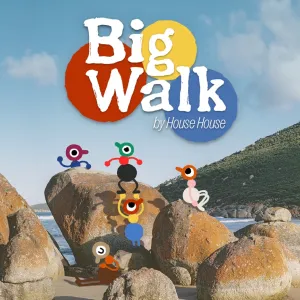
Big Walk is a cooperative online adventure from House House, the Melbourne studio behind Untitled Goose Game, published by Panic. Between two and twelve players explore a large, bushland-inspired open world together — the environment is explicitly modeled on Wilsons Promontory National Park in Victoria, Australia — solving puzzles that are built around communication rather than reflexes or combat, because there isn't any combat, or much of a fail state at all. It launched on Windows and macOS with cross-platform multiplayer, priced at $14.99 during a launch discount off its regular $19.99, and it's currently sitting at a "Very Positive" rating with roughly 94% of over 11,000 English-language Steam reviews approving of it.
The pitch designer Jake Strasser has given for the game's philosophy is that it needed just enough structure to keep a group moving forward together, while staying "relaxed enough that you're mostly just able to enjoy spending time with your friends." That's a genuinely different design goal than most co-op games aim for, and it shows up in almost everything about how the game plays. It's also a notable creative left turn for the studio in another way: where Untitled Goose Game was a tightly scripted solo experience built around one character's mischief, Big Walk hands most of the actual content generation over to whichever group happens to be playing together at the time, which means the studio's design philosophy carried over even though almost nothing about the format did.
The soundtrack is worth mentioning here too, since it's doing more structural work than background music usually does in this genre. Composers Sam Gill and Luke Neher, working under the name AKSFX, built the score to be diegetic — meaning the music comes from objects and moments inside the world itself rather than playing over the action from nowhere, which reinforces the same "you're actually here, together" feeling the proximity chat is built around.
What Do You Actually Do in It?
The core loop is exploration built around a resource called gourds. Puzzles scattered across the island reward you with them on completion, and delivering five gourds to any of four towers unlocks a key that expands the accessible map and opens up shortcuts back through territory you've already crossed. There's no fast travel and no hand-holding — if you want to get somewhere, you and your group walk there, which is very much the point rather than an oversight.
What makes the puzzles distinct is how directly they depend on the specific tools the game hands you: walkie-talkies, binoculars, a shared whiteboard, and gesture-based communication for moments when speaking isn't an option, layered on top of proximity voice chat that changes quality based on distance and whatever's physically between you and your teammates. One puzzle might require someone to guide a blindfolded partner by voice alone; another might need coordinated light signals visible only from specific vantage points.
The puzzles also scale to however many people are actually playing, so a two-person session and a twelve-person session aren't just the same content with extra bodies standing around — they're meaningfully reconfigured for the group size. A puzzle that plays as a tense two-person trust exercise when you're down to a small group can turn into an organized-chaos logistics problem with twelve people all trying to relay instructions at once, and the game doesn't just tolerate that shift, it seems to be actively designed around producing it.
Carrying capacity is deliberately limited too — you can typically only hold one item at a time — which sounds like a small detail until it forces a group to actually plan a supply chain of gourds and tools back and forth across a puzzle site instead of one player just hoarding everything needed and solving it alone.
Is It Actually Fun, or Just a Fancy Walking Simulator?
This is the question that decides whether the game is for you, and the honest answer is that it depends entirely on whether you're playing with people you actually want to talk to. Reviewers have compared the puzzle design favorably to Portal 2's co-op campaign for the way complexity escalates and new mechanics keep getting introduced rather than recycling the same trick — one reviewer specifically noted that solving Big Walk's puzzles "pushes critical thinking and problem-solving to the limit" in ways that feel genuinely fresh puzzle to puzzle rather than reskinned.
Since almost every puzzle requires real coordination rather than one person quietly solving it. In contrast, others watch, it plays much closer to a structured social hangout than to a traditional adventure game. Early previews at Steam's Day of the Devs showcase picked up on exactly that: Destructoid noted it "feels like a game where no two play sessions are the same," which lines up with how dependent the puzzles are on who you're playing with and how well you communicate under pressure.
What's the Catch?
The most consistent complaint across reviews is downtime. Because there's no fast travel and the island is genuinely large, the walking between puzzle locations can stretch into tedium, especially once a group has already cleared the puzzles in an area and is just covering ground to reach the next one. The landscape itself draws criticism too — several reviewers describe it as visually bland and largely colorless compared to the personality-packed puzzle design, which is a strange gap for a studio that made a goose felt like a fully realized character through art direction alone.
Getting separated from your group is its own recurring problem: because proximity voice chat means you lose contact with teammates who wander too far, and because the world doesn't hold your hand back toward each other, groups can lose real chunks of a session just trying to physically reunite before the next puzzle can even start. None of these are the kind of flaws that break the game so much as ones that test a group's patience — a party that's genuinely enjoying each other's company will treat getting lost together as part of the fun, while a group that's only half paying attention will feel every minute of it as dead time, which makes the actual experience of playing Big Walk unusually dependent on who happens to be in the session with you rather than anything the developers could fully control through design alone.
Should You Buy It Right Now?
At $14.99 during the launch discount, and with review sentiment holding steady in the "Very Positive" range across more than fifteen thousand total reviews, the price-to-quality ratio is hard to argue with if you already have a group of two to four people who'll actually commit to a session together — this genuinely is not a game to buy for solo play, since the entire design depends on other people being on the other end of the walkie-talkie.
It's currently available on Windows and macOS, with a PlayStation 5 version confirmed as part of the original announcement but not yet live alongside the PC release, so console players specifically should hold off and watch for that platform's launch rather than assuming day-one parity. For anyone whose group liked Untitled Goose Game's sense of humor and is looking for something built around actual conversation instead of one-liners, Big Walk is close to exactly what that description promises, tedious walking stretches and all.
Verdict
Recommended, but specifically for a committed group of friends rather than as a solo purchase or a game for strangers matched online — the entire design assumes people who'll actually talk to each other and stick with a session, and it falls apart without that. If you've got two to four people who enjoyed the personality behind Untitled Goose Game and want something built around real conversation instead of physical comedy, this is worth the current discounted price despite the walking fatigue. Skip it, or at least wait, if your group leans toward solo play or if a visually flat open world without fast travel sounds like a dealbreaker rather than a feature.
- Puzzle design escalates in genuinely inventive ways, earning comparisons to Portal 2's co-op campaign
- Communication tools like walkie-talkies, whiteboards, and proximity voice chat make teamwork feel essential rather than optional
- Puzzles dynamically scale to however many players are actually in a session, from two up to twelve
- "Very Positive" rating holds steady across more than fifteen thousand reviews
- Launch discount brings it to $14.99, a fair price for a game built to be replayed with different groups
- No fast travel means walking between puzzle locations can become genuinely tedious
- The landscape is visually flat and colorless compared to the sharpness of the puzzle design